Technology Profile
| Title: | Even Solar Sharing Agrivoltaics |
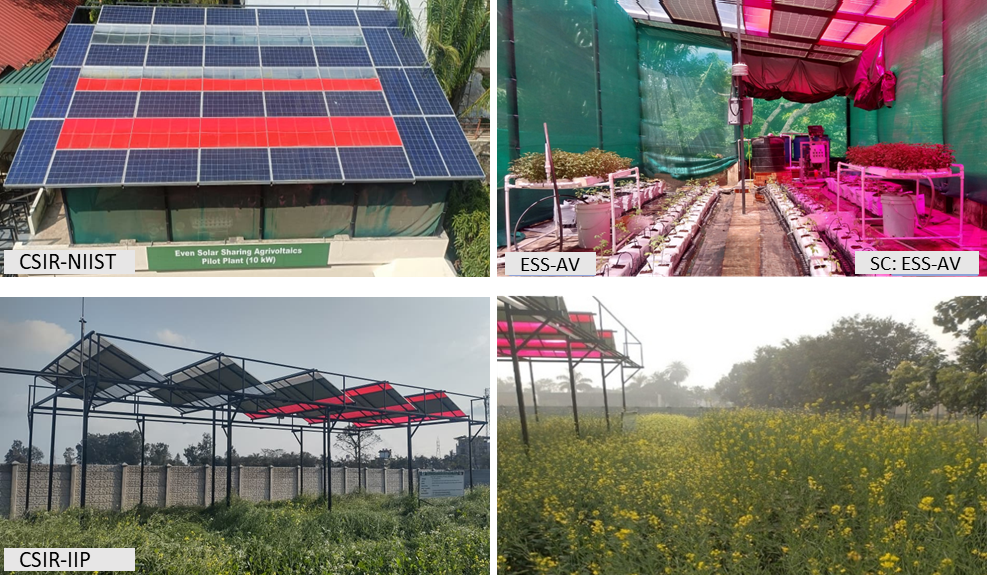
| Value Proposition: | Even Solar Sharing Agrivoltaics (ESS-AV), developed by CSIR–National Institute for Interdisciplinary Science and Technology, is a next-generation agrivoltaic solution that enables simultaneous optimization of agricultural productivity and photovoltaic energy generation through precision solar radiation management. By integrating tunable ray-spreading optics and spectral conversion mechanisms, ESS-AV ensures controlled distribution and spectral tuning of sunlight to match crop-specific Photosynthetic Photon Flux Density (PPFD) requirements while maintaining high photovoltaic output. This technology directly supports India’s priorities on sustainable energy transition, climate-resilient agriculture, efficient land utilization, and farmer income enhancement, offering a scalable pathway for dual land productivity with improved resource-use efficiency. With TRL-7 validation, supported by year-round field trials and Key Performance Indicators (KPIs), ESS-AV demonstrates strong techno-economic viability. The system enables improved returns through dual-use productivity and optimized energy yield, offering faster payback compared to conventional ground-mounted PV installations. Furthermore, it is positioned for commercial deployment and retrofitting of existing PV infrastructure into productive agrivoltaic systems. |
| Summary Application: | Even Solar Sharing Agrivoltaics (ESS-AV) enables precision-integrated deployment of agriculture and solar energy systems across diverse use cases by addressing conventional shading and spectral inefficiencies. The technology is primarily applied in advanced agrivoltaic farming systems, where precision diverging optics ensure uniform solar radiation distribution, mitigating the adverse shading effects of conventional PV panels. Through spectral optimization (green-to-red light conversion), ESS-AV enhances Photosynthetically Active Radiation (PAR), thereby improving crop productivity and growth efficiency. ESS-AV is also suitable for water-stressed and climate-vulnerable regions, as it reduces evapotranspiration, stabilizes the crop microclimate, and alleviates crop thermal stress, enabling water-efficient and climate-resilient agriculture under partial shading conditions. Further, the system supports high-density integration of photovoltaics with agriculture, allowing increased PV coverage (14–27.3%) without compromising crop yield, thus maximizing land-use efficiency and energy generation. Additionally, ESS-AV offers strong potential for retrofitting existing solar power plants into productive agrivoltaic systems through its pole-height tunability, unlocking dual land-use benefits. The technology is also adaptable to controlled environment agriculture, including greenhouses and Building Integrated Agrivoltaics (BIAV), where it can function as a multifunctional roofing solution, combining energy generation with optimized crop cultivation environments. |
| Advantages: | Agronomic Benefits
Resource Efficiency
Energy & Land Productivity
Technological Innovations
Scalability & Deployment
Expandable to greenhouse and BIAV applications |
| Tech. Readiness Level: |

: director[at]niist[dot]res[dot]in
:91-471- 2515226
:https://www.niist.res.in