CSIR Technology Portal

 Technology Profile

Title:

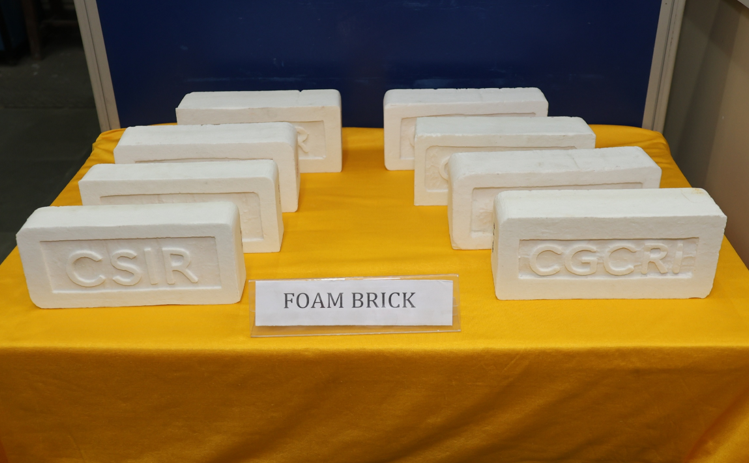
Glass Foam bricks for Construction and Insulation Application

Value Proposition:
  • A method of utilizing more than 98 wt.% of waste glass to develop glass foam to avoid water, soil and environment pollution and recycling the resource to contribute in circular economy. The glass waste can be used as main raw material to develop glass foam causing no contamination to the environment. Therefore, safe disposal and maximum utilization of glass waste is ensured.
  • Low temperature (700 to 760oC) fabrication of glass foam consume less energy and this leads to minimizes cost of production.
  • The glass foam can be utilized for specific product like bricks and tiles (with varying density and porosity) depending on the requirement.
  • Light weight glass foam bricks and tiles with improved thermal conductivity (0.062-0.2 W/m.K) will be useful as insulation material for building and industry particularly in outer layer of furnace/oven body. 
  • Glass foam brick with compressive strength 5-10 MPa and density 0.3-0.4 g/cc would be useful as building construction. This bricks have potential to reduce building load and minimize energy consumption of the building. High density glass foam required more raw material for fabrication. Therefore, improving compressive strength with low density material helps to minimize raw material requirement.
Summary Application:

Lightweight foam glass from glass wastes would have significant impact on environment and resource utilization due to use of 98-99% waste glass. Foam glass is considered to be one of the most environmentally friendly, durable and efficient thermal insulators. Some of the desirable properties includes high material strength, light weight, low thermal conductivity, fast and easy to install, weather independent placing, stabilizing on weak construction ground e.g. peat, thermal insulation mitigating frost damage, capillary breaking layer (high drainage capacity), incombustible and chemical resistant, minimal leaching, does not rot and keeps in shape, electrical and sound insulating, pest proof.
These properties have enabled its use in a range of applications such as insulation floor slab for buildings but also including construction of roof gardens, backfill around swimming pools and pipelines, low density fill above tunnels and structures and construction of sports fields. Foam glass panels are used worldwide for building cladding and pipe insulation in industry. Improved mechanical strength of this present brick has potential to use in building construction, where energy demand is critical. Moreover, these bricks can be used in furnace outer layer.

Advantages:

Lightweight glass foam requires less material to fabricate, and waste utilization of a maximum of 99% makes it a very promising waste glass recycled process. Utilization of waste glass maximum up to 99% is used to fabricate glass foam bricks unlike utilization of 97% glass waste is mentioned elsewhere. Present invention revels use of single foaming agent to obtain uniform porosity. Low temperature fabrication minimizes pore diameter and less foaming agent prohibits coalesces of multiple bubbles and thereby improve compressive strength (CS) of more than 5 MPa.

Commercialization Status: Already Commercialised
Tech. Readiness Level:
CSIR-Central Glass and Ceramic Research Institute
CSIR-Central Glass and Ceramic Research Institute[CSIR-CGCRI]
:  director[at]cgcri[dot]res[dot]in
:91-33- 24735829
:https://www.cgcri.res.in
Industrial Applications: Building Materials [Building Materials, Construction Technologies, Furniture etc.] Glass [Materials] Inorganic materials [Chemistry, Chemical Processes] Recycling [Environmental (Clean Tech.)] Waste management [Environmental (Clean Tech.)]
Patent Application(s): IN202411045190, WO2025257847
Photograph(s)