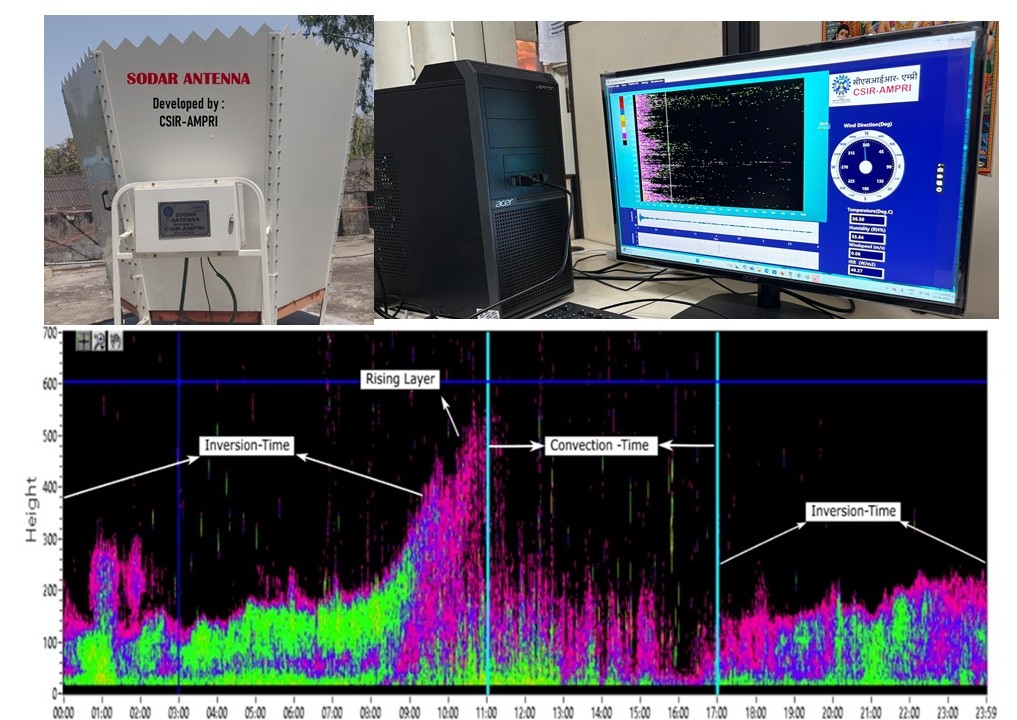
Technology Profile
| Title: | Indigenous SODAR System |
| Value Proposition: | Sound Detection And Ranging (SODAR) is an acoustic remote sensing technique for real-time monitoring of Atmospheric Boundary Layer (ABL) and thermal structures of concern in air pollution meteorology. It is internationally recognized and recommended by the Environmental Protection Agency (EPA) for air quality dispersion modeling in Environmental Impact Assessment (EIA). This technique is in use all over the world for various practical and ABL research applications. ABL is a fundamental parameter characterizing the structure of the lower atmosphere. Occurrence characteristics of the meteorological processes associated with ABL thermal structures such as inversion and thermally convective mixing height, stability, transitional phases of stable/ unstable atmosphere, etc. play a significant role in determining the atmospheric carrying capacity of pollutants load. Therefore, knowledge of such city specific air pollution meteorological aspects is the back bone of planning strategies for city air quality management. CSIR - AMPRI indigenously developed a software for a new design of monostatic SODAR, data acquisition, and control system with minimized hardware elements. The user-friendly system runs without problems and provides continuous real-time data on the dynamics of ABL thermal structures. |
| Summary Application: | Lower atmosphere (i.e., the lower part of the troposphere) research is important because it helps us understand and predict weather patterns, monitor air quality, and support climate prediction/forecasting. It also provides information which is helpful for urban planning, disaster management, thus protects public health. For real-time monitoring of the lower atmosphere, Sound Detection And Ranging (SODAR) is an acoustic remote sensing technique which is internationally recognized and recommended by the Environmental Protection Agency (EPA) for air quality dispersion modelling in Environmental Impact Assessment (EIA). This technique is in use all over the world for various practical and atmospheric research applications. CSIR-AMPRI’s SODAR is an unique option for research in the lower atmosphere. The salient features are as follows:
This SODAR system provides a self-sufficient solution for atmospheric research and environmental monitoring, supporting national initiatives such as National Clean Air Programme (NCAP), National Mission for Sustaining the Himalayan Ecosystem (NMSHE), Mission Mausam and the Smart Cities Mission. It's a self-reliant, affordable solution tailored for India's need. An MoU was signed between CSIR-AMPRI, Bhopal and IMD, New Delhi, MoES to enhance collaborative research work between CSIR-AMPRI, Bhopal and IMD New Delhi, MoES in climate and environmental studies with emphasis on scientific and societal challenges related to weather, climate variability, forecasting and disaster risk reduction. The MoU facilitates the sharing of SODAR system data across various locations for forecasting, validation, and research initiatives. |
| Advantages: |
|
| Commercialization Status: | Licensed awaiting commercialisation |
| Tech. Readiness Level: |

: director[at]ampri[dot]res[dot]in
:91-755- 2457105
:https://ampri.res.in