Technology Profile
| Title: | Novel Small Molecule Potential to Treat Carbapenem-Resistant Entereobacteriace (CRE) Infections |
| Value Proposition: | AMR is a global unmet health problem. The solutions developed i.e. effective novel pan-MBLs inhibitors have the potential to be sold globally and hence have high potential commercial value. Considering fewer ongoing efforts and huge unmet medical needs, many big and small pharmaceutical industries (national and international), will be interested to in-license any potential molecule showing promise in treating AMR infections. |
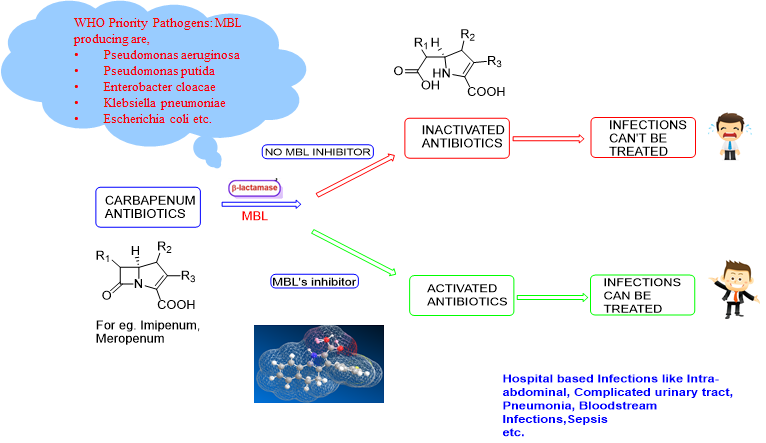
| Summary Application: | Beta-lactam antibiotics are the cornerstones of antimicrobial chemotherapy. However, antimicrobial resistance against these life-saving drugs is a major public health problem worldwide. Resistance to beta-lactam antibiotics among Gram-negative bacteria is mainly due to the production of beta-lactamases, which inactivate these life-saving drugs. Bacteria achieve resistance by these challenging chemical reactions with two types of enzymes: serine β-lactamases and/or metallo-β-lactamases (MBL). Recently few serine beta-lactamase inhibitors have been approved, but to date, not a single MBL inhibitor is approved or in the clinic. So, there is an urgent unmet medical need to discover a new ideal MBL inhibitor, which can be used as an adjuvant with FDA-approved beta-lactam antibiotics and would be beneficial in difficult-to-treat hospital-based infections. |
| Advantages: | The salient features of this technology are:
|
| Tech. Readiness Level: |