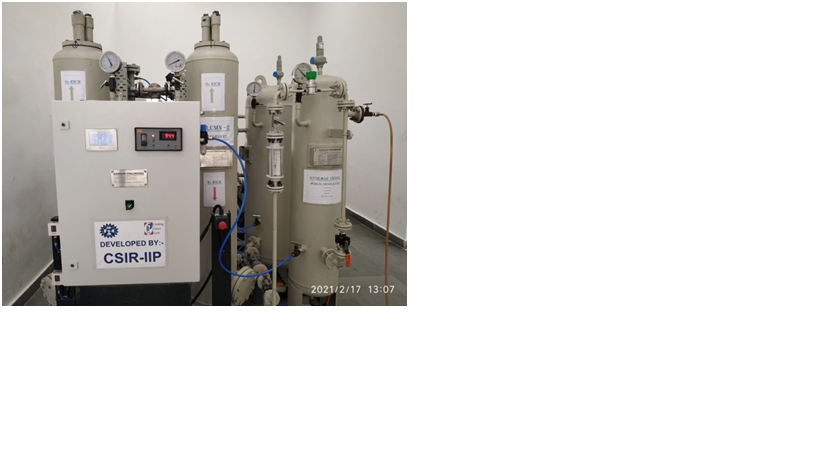
Technology Profile
| Title: | Pressure Vacuum Swing Adsorption (PVSA) Technology for Medical Grade Oxygen (MO2) Production |
| Value Proposition: | Efficient Pressure Vacuum Swing Adsorption (PVSA) Technology for the Generation of Medical Grade Oxygen (MO2) Meeting I.P. 2018-PSA-Oxygen Specifications for the Onsite Hospital Use. CSIR-IIP is a centre of excellence for development of cutting edge ‘Adsorption Based Separation Processes’ for variety of applications such as CO2 Capture, H2 Recovery from Refinery Off-gases, Helium and Propylene Recovery, Production of Ultra Low Sulfur Diesel Meeting BS-VI specification, PVSA Process for Bio-gas Up-gradation etc. Recently, CSIR-IIP has developed a Pressure Vacuum Swing Adsorption (PVSA) process which is superior to traditional Pressure Swing Adsorption (PSA) process for production of ‘Medical Grade Oxygen’ using same class of adsorbent. In India, during COVID-19 pandemic, the entire supply-chain of ‘Medical Grade Oxygen’ was severely disrupted due to significant increase in COVID-19 infected patients in the country with the result steep and sudden rise in demand of ‘Medical Grade Oxygen’ across the country from 3,842 MT per day on 12 April 2021 to 8,400 MT per day by 25 April 2021 and further up to 11,000 MT per day by the beginning of May 2021. Many hospitals across India faced a severe shortage of ‘Medical Grade Oxygen’ for treatment of Covid-19 patients and regular usage. This problem was noted during the peak of first wave in September 2020 and recurred on a much larger scale during the peak of the second wave during April to May 2021.The reason for short supply of ‘Medical Grade Oxygen’ was not a lack of ‘Medical Grade Oxygen’, per se, but inadequate distribution network of tankers for transportation of liquid oxygen from the point of manufacture and supply of oxygen gas cylinders to the hospitals. Therefore, an urgent need was felt for a distributed and self-reliant oxygen production from ambient air at the site of hospital to eliminate the transportation issue, transportation cost and to ensure sustained supply of ‘Medical Grade Oxygen’ to the patients in hospitals. |
| Summary Application: | In conventional Pressure Swing Adsorption (PSA) process operated for medical grade oxygen (MO2) generation, ambient air is compressed followed by removal of moisture, particulates, and oil. This is then fed to an adsorber tower filled with adsorbents in order to pressurize it up to 6-7 bar pressure followed by withdrawal of the oxygen enriched product gas meeting medical grade oxygen specifications from the other end of the adsorber, opposite to the compressed air feed entry end. The adsorber is typically filled with activated alumina and synthetic LiX zeolite beads in a layered fashion. Activated alumina adsorbs residual moisture present in the compressed air while the zeolite adsorbs CO2 and N2 allowing oxygen and argon to pass through unrestricted. In the process oxygen gas gets enriched from 21% level in ambient air to 93±3% level. The zeolite due to its limited capacity for nitrogen (N2), gets quickly saturated and is regenerated in-situ by countercurrent blow down to atmosphere. In contrast to conventional PSA, the bed regeneration in CSIR-IIP’s Pressure Vacuum Swing Adsorption (PVSA) process is more efficient and is done by applying vacuum, countercurrent to the feed (air) flow direction. |
| Advantages: | Novelty of CSIR-IIP’s PVSA vis-à-vis Conventional Technologies
|
| Commercialization Status: | Already Commercialised |
| Tech. Readiness Level: |