Technology Profile
| Title: | Process for Production of Decaffeinated Tea |
| Value Proposition: | Tea is increasingly popular due to its numerous health benefits. However, tea contains 3-4% caffeine, which causes problems for many tea drinkers as caffeine causes irritation in gastrointestinal tract, sleeplessness, cerebral cortex stimulation and activates the central nervous system. High tea addiction among Asian and North American consumers is predicted to drive the growth of the decaffeinated tea market, as customers seek healthy tea and coffee alternatives to prevent sickness and stay healthy. Decaffeinated tea market, which was worth USD 2.1 billion in 2022, is predicted to be worth USD 5.1 billion by 2030, representing an 11.1% CAGR during the forecast period. As per prior art, different decaffeination processes exist, but they remain limited by issues of cost, safety, sustainability, or product quality. |
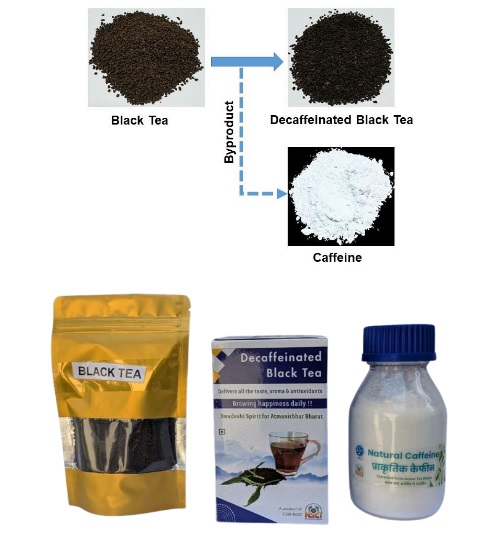
| Summary Application: | CSIR NEIST has developed a Process for production of decaffeinated tea, which is a green and economically viable method for selective caffeine extraction from black tea using environmental friendly solvents. The process achieves efficient caffeine removal while retaining tea quality and appearance. The final decaffeinated product appearance intact with absence of inorganic (As, Sn and Hg- below level of quantification, and Pb, Cu, Cd well below permissible limits). All pesticides analysed in accordance to EU regulation (EC) 396/2005 and found to below limit of quantification. Residual solvent test ensures absence of solvents in finished product. This will provide an industrial-scale feasible and environmentally safer alternative to the prior art. |
| Advantages: |
|
| Commercialization Status: | Licensed awaiting commercialisation |
| Tech. Readiness Level: |