Technology Profile
| Title: | Process Know-how for preparation of Biomass Derived Materials |
| Value Proposition: | Biochar technology offers a transformative, value-added solution for the construction industry by integrating sustainability, performance and cost-effectiveness. Derived from waste biomass through pyrolysis, biochar acts as a multi-functional additive or partial cement substitute in concrete, mortar and bricks. It contributes to carbon-negative construction, reducing the reliance on energy-intensive cement, while providing long-term carbon sequestration. Biochar increases durability, thermal insulation and water retention due to its porous structure, and improves crack resistance and shrinkage control. For stakeholders from infrastructure developers to green builders - biochar enables compliance with green building certifications (e.g., LEED, GRIHA), supports circular economy goals and reduces the environmental footprint of construction. Scalable and customizable, this technology combines high-performance construction with environmental responsibility, providing a clear advantage in the transition towards net-zero built environments. |
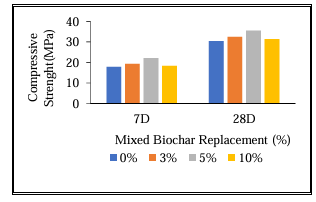
| Summary Application: | Concrete and Cementitious Composites • Acts as a partial cement replacement or filler. • Enhances mechanical properties (compressive strength, durability) at optimized dosages. • Improves thermal insulation and reduces permeability. • CO2 Sequestration Asphalt and Bitumen Modifiers • Improves stability and longevity of pavement materials. |
| Advantages: | Biochar offers several benefits when incorporated into building materials such as concrete, mortar, and bricks. It improves sustainability by utilizing waste biomass, reducing carbon emissions, and potentially sequestering carbon in the built environment. Due to its porous structure, biochar enhances internal curing, reduces drying shrinkage, and improves insulation properties. It can also refine the pore structure of cementitious matrices, contributing to increased durability and reduced permeability. In addition, biochar-modified composites often exhibit lighter weight, making them suitable for energy-efficient and green building applications. |
| Commercialization Status: | Licensed awaiting commercialisation |
| Tech. Readiness Level: |